
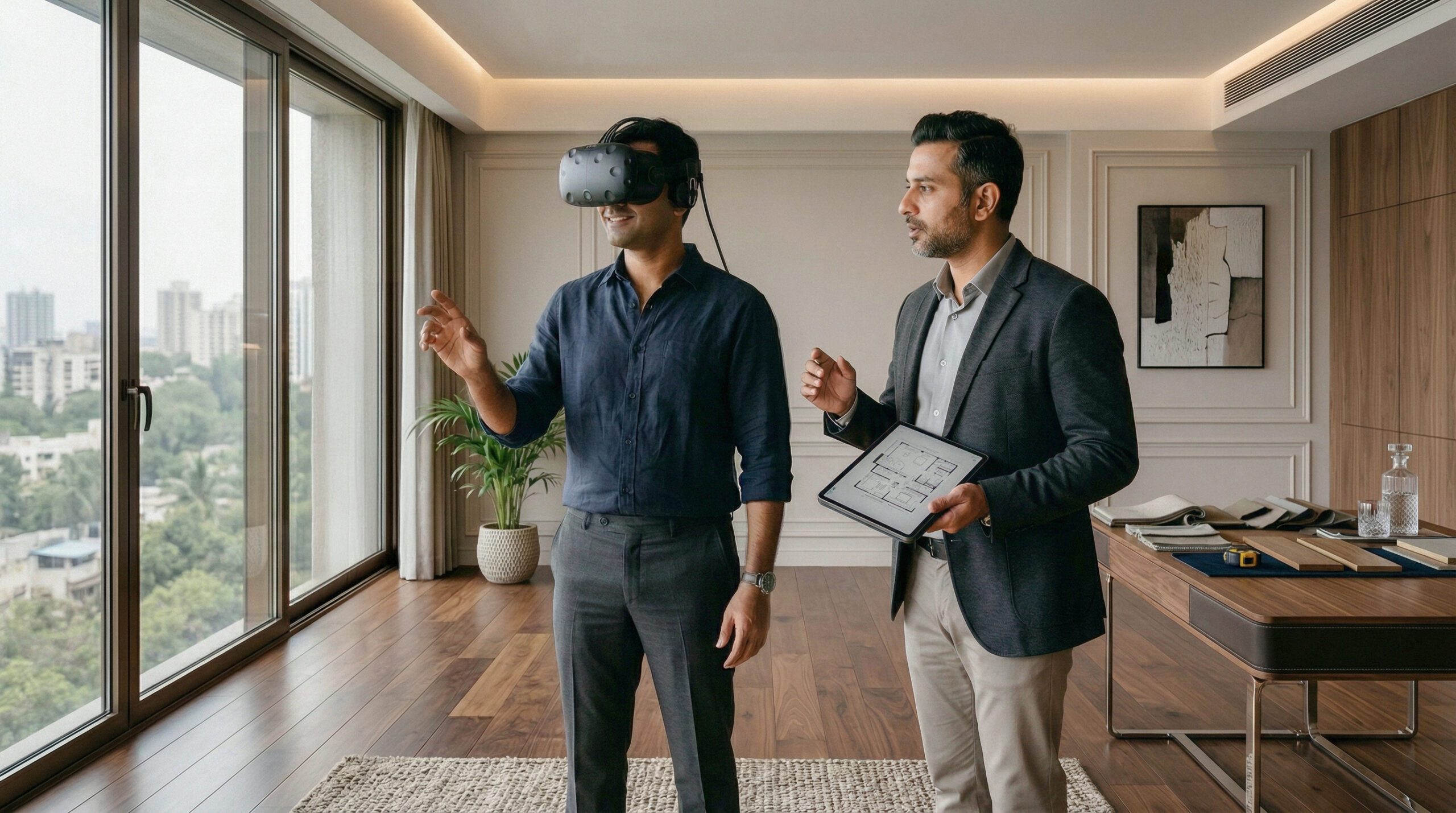
The gap between what a client envisions and what is actually constructed has always been a frustrating aspect of interior design. Designers filled the gap for decades with hand-drawn sketches, mood boards, and a lot of “trust me, it’ll look great.” It did occasionally. It didn’t always. In any case, clients were effectively approving something they were unable to fully understand.
That’s starting to change in a real way.
Virtual Interior Design Services are giving people the ability to walk through a space before a single wall goes up. Not a flat plan to squint at, not a rendering to interpret — an actual, navigable environment. You stand in it. You look around. You decide if that open-plan layout actually feels as airy as it looked on paper, or whether the dining area is just… a bit cramped.
From blueprints to walkthroughs
Traditional interior design has always leaned heavily on 2D communication — floor plans, elevations, and technical drawings. These are useful, but they demand something from the client: the ability to mentally translate lines and measurements into a lived experience. That’s a skill most people don’t have, and it’s responsible for a lot of misaligned expectations.
VR eliminates the translation process. You follow a plan rather than deciphering it. You can sense whether the light from the west-facing window complements or detracts from the space, whether the ceiling is low, and with AR Furniture Visualization, you can see whether the furniture arrangement permits easy mobility. The uncertainty vanishes, along with the anxiety that often follows significant design choices.
This is equally useful for designers. fewer rounds of revision. approvals that truly endure. customers who are self-assured instead of merely obedient.
Testing ideas without the consequences
One of the quieter stresses of interior design is the weight of decisions made in the abstract. Choosing a floor finish, a paint colour, a layout — each carries real financial stakes, and you’re usually committing before you can fully evaluate.
Virtual environments let you run experiments freely. Want to see how a deep charcoal wall reads against your flooring? Done in seconds. Curious whether the room feels different in afternoon light versus morning? That’s simulable too. You can try a dozen versions of a space without ordering a single sample or moving a single piece of furniture.
This kind of low-stakes iteration changes the client dynamic noticeably. People stop just approving designs and start genuinely shaping them. The feedback gets sharper. The outcomes get better.
AR: design decisions in your actual living room
While VR builds entirely new environments, augmented reality does something slightly different — it drops digital objects into real ones. Point your phone at your living room, and that sofa you’ve been considering appears in the actual corner you had in mind. Right scale, right colour, positioned exactly where it would live.
For the kinds of decisions that feel small but actually matter — does this coffee table overwhelm the space? Does this rug tie the room together or fight it? — AR is remarkably practical. Retailers have observed that consumers buy with greater conviction and return items much less frequently when they can see them in their homes.
Reduced misunderstandings and expensive surprises
In construction and renovation, there is a well-known tale: something was lost between the designer’s intent and what the contractors constructed, despite the design appearing one way on paper. These misunderstandings are very common, costly, and time-consuming.
That narrative becomes significantly less common when all parties involved have access to a virtual walkthrough of the final design prior to the start of work. Contractors are aware of the goals they are pursuing. The outcome doesn’t surprise stakeholders. Presenting a fully navigable virtual space to decision-makers can significantly reduce approval timelines for large commercial projects, such as offices, retail stores, and hospitality settings.
3D planning that actually thinks
The 3D Room planning service has moved well beyond creating pretty images. The better tools now build environments that respond — incorporating real spatial data, lighting analysis, and even material behaviour. You can test how a layout affects foot traffic, how surfaces interact with both natural and artificial light, or whether a particular acoustic treatment makes sense for a space.
These are insights that were genuinely difficult to access with traditional methods. Now they’re becoming part of routine design practice.
Making design accessible to everyone in the room
Interior design has always been collaborative in theory. In practice, clients who couldn’t read technical drawings were often passive participants — reviewing images they partially understood and hoping for the best.
Immersive tools level that. When a designer and client can explore a space together, point at things, suggest changes, and see them reflected in real time, the collaboration becomes genuine. The client doesn’t need specialized knowledge to contribute meaningfully. They just need to look around and share what they feel.
The sustainability angle
It doesn’t get talked about as much, but there’s a real environmental case for this technology too. Wrong finish ordered. Wrong furniture delivered. Rework that consumes additional materials. These are wasteful outcomes that better upfront decision-making can prevent. When you’ve already tested a space virtually and made your choices with confidence, the execution becomes far more precise — and the material waste drops accordingly.
The challenges are real, but shrinking
There is friction in all of this. VR gear is expensive. New workflows must be learned by designers. Some customers lack access to or are uncomfortable using headsets. Furthermore, allowing technology to dictate a process that is essentially about the human experience—spaces that feel meaningful rather than merely technically impressive—raises valid concerns.
These are reasonable factors. However, the barriers have decreased over the past two years and will continue to do so in the next two. Over time, the accessibility issue tends to be resolved as technology becomes more commonplace and less exotic.
The Future of VR & AR
The use of VR and AR in interior design is not a passing trend. They signify a real change in the way the field operates, one that is enhancing precision, strengthening teamwork, and closing the gap between goal and result.
The need for designers who genuinely comprehend how spaces impact people won’t change. The equipment is superior. “Try before you build” used to be a good idea, but the vision still needs to come from somewhere human. Silently, it’s starting to become the norm.